
Blast from the Past1976 1977
The Queen He Saw Coming: how Geller stunned Karpov, and how Karpov answered a year later
In 1976 Efim Geller sacrificed his queen against the world champion, and Karpov saw it coming. A year later Karpov answered with a queen sacrifice of his own. Two games, verified move by move.

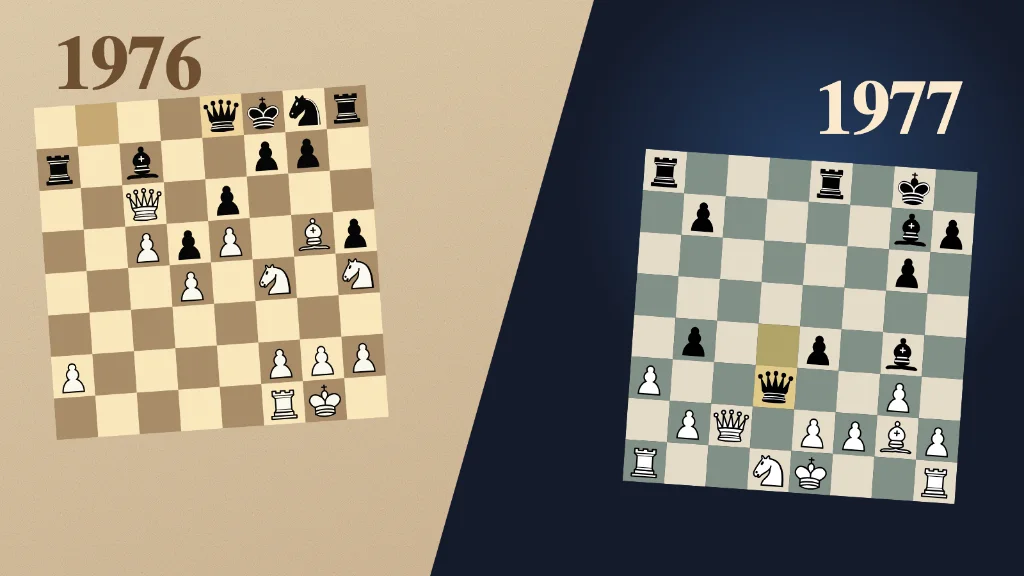
Moscow, 1976. The world champion has just moved his queen to e8. It attacks White's queen and offers a trade, and a trade would leave Black with the better game. Then Anatoly Karpov looks at the board again, and sees what his opponent can do instead.
He could not stop it. Years later he wrote it down himself, in a book: "I saw White's combination, but I could not prevent it." (source)
Geller–Karpov, Moscow 1976: White to move


 7

 6
 5

 4
 32a1bcdef
 g
 h
- 1
- 2
- 3
- 4
- 5
- 6
- 7
- 8
- 9
- 10
- 11
- 12
- 13
- 14
- 15
- 16
- 17
- 18
- 19
- 20
- 21
- 22
- 23
- 24
- 25
- 26
- 27
- 28
- 29
- 30
- 31
- 32
- 33
- 34
- 35
- 36
- 37
- 38
- 39
- 40
- 41
- 42
1-0
The position Karpov describes, after 24…Qe8. White's queen on c6 is attacked. Find White's move before you press ▶.
Opens in a new tab at the position on this board. The master database indexes the first 15 moves, so this deeper position opens without master statistics.
Take a minute with that position. The rest of this story is about what Efim Geller found there, how close he came to missing it, and how Karpov, one year later, turned the same idea against someone else.
The book also appeared in English as Chess Kaleidoscope (1981). The games below have been checked move by move against the book, our master database and independent sources, listed at the end.
Act I: the champion under pressure
The game was played at the 44th USSR Championship in Moscow. Karpov had been world champion since 1975; Geller, one of the great attacking players of his generation, knew his chess well, having helped him prepare for his Candidates final against Korchnoi. (source)
Karpov chose the French Defence, the Winawer: 1.e4 e6 2.d4 d5 3.Nc3 Bb4 4.e5 Qd7. By his own account the game did not go smoothly. He got into difficulties, Geller increased the pressure move by move, and Black's king never castled.
After 20…Bc7: White to move
765432a1bcdefgh- 1
- 2
- 3
- 4
- 5
- 6
- 7
- 8
- 9
- 10
- 11
- 12
- 13
- 14
- 15
- 16
- 17
- 18
- 19
- 20
- 21
- 22
- 23
- 24
- 25
- 26
- 27
- 28
- 29
- 30
- 31
- 32
- 33
- 34
- 35
- 36
- 37
- 38
- 39
- 40
- 41
- 42
1-0
Black's knight on b8 is the piece holding things together: it guards c6 and d7. How can White get rid of it?
Opens in a new tab at the position on this board. The master database indexes the first 15 moves, so this deeper position opens without master statistics.
Show Geller's answerFor advanced readers
21.Rxb8+! An exchange sacrifice: Geller gives a rook for the knight. After 21…Qxb8 22.Qxc6+ the queen lands on c6 with check, winning a pawn, and after 22…Kf8 Black's king is stuck in the corner of its own camp. Then 23.Nf4 Ra7 24.Nh4: both knights head for g6.
After 24…Qe8, the position from the start of this story, Karpov offered the trade of queens. Retreat, or trade, and Black is better.
Act II: the move Karpov saw coming
Here Geller had only one winning move, and he was short of time. Karpov writes that Geller was in severe time trouble and, he believes, did not see the blow at once. He found it at the last moment. (source)
The combination, step by step
765432a1bcdefgh- 1
- 2
- 3
- 4
- 5
- 6
- 7
- 8
- 9
- 10
- 11
- 12
- 13
- 14
- 15
- 16
- 17
- 18
- 19
- 20
- 21
- 22
- 23
- 24
- 25
- 26
- 27
- 28
- 29
- 30
- 31
- 32
- 33
- 34
- 35
- 36
- 37
- 38
- 39
- 40
- 41
- 42
1-0
Press ▶ to play 25.Qxe6!! fxe6 26.Nfg6+ Qxg6 27.Nxg6+ Ke8 28.Nxh8, one move at a time.
Opens in a new tab at the position on this board. The master database indexes the first 15 moves, so this deeper position opens without master statistics.
25.Qxe6!! The queen walks into a pawn's capture. After 25…fxe6 26.Nfg6+ the knight checks a king hemmed in on f8 by its own knight on g8 and rook on h8. Karpov took it, 26…Qxg6, and 27.Nxg6+ Ke8 28.Nxh8 won back the queen and took the rook as well.
After 28.Nxh8: pause and count
765432a1bcdefgh- 1
- 2
- 3
- 4
- 5
- 6
- 7
- 8
- 9
- 10
- 11
- 12
- 13
- 14
- 15
- 16
- 17
- 18
- 19
- 20
- 21
- 22
- 23
- 24
- 25
- 26
- 27
- 28
- 29
- 30
- 31
- 32
- 33
- 34
- 35
- 36
- 37
- 38
- 39
- 40
- 41
- 42
1-0
Who is better, and why? Count the material, then look at the knight on h8.
Opens in a new tab at the position on this board. The master database indexes the first 15 moves, so this deeper position opens without master statistics.
Show the answerFor advanced readers
The pieces are level: rook, bishop and knight each. But White has three extra pawns, and a passed c-pawn. The catch is the knight on h8, stranded in the corner. The combination is over; the game is not.
Act III: the brilliance after the brilliance
What makes this game a lesson rather than just a trick is what Geller did next. The fireworks gave way to an endgame, and the endgame had to be won.
He freed the knight with 31.Ng6+ and 32.Nf4. Karpov gave his bishop for the e5-pawn and won the knight back, 32…Bxe5 33.dxe5 Rxf4, but that left a rook endgame with six white pawns against four. Then 34.Rc1! put the rook behind the passed c-pawn; 35.c6 and 36.c7+ tied Black's king to c8, and once the e6-pawn fell, the e-pawn ran.
After 33…Rxf4: technique takes over
65432a1bcdefgh- 1
- 2
- 3
- 4
- 5
- 6
- 7
- 8
- 9
- 10
- 11
- 12
- 13
- 14
- 15
- 16
- 17
- 18
- 19
- 20
- 21
- 22
- 23
- 24
- 25
- 26
- 27
- 28
- 29
- 30
- 31
- 32
- 33
- 34
- 35
- 36
- 37
- 38
- 39
- 40
- 41
- 42
1-0
A rook endgame with six white pawns against four, and a passed c-pawn. Press ▶ to watch 34.Rc1! and the pawns advance.
Opens in a new tab at the position on this board. The master database indexes the first 15 moves, so this deeper position opens without master statistics.
Final position, after 42.e7
65432a1bcdefgh- 1
- 2
- 3
- 4
- 5
- 6
- 7
- 8
- 9
- 10
- 11
- 12
- 13
- 14
- 15
- 16
- 17
- 18
- 19
- 20
- 21
- 22
- 23
- 24
- 25
- 26
- 27
- 28
- 29
- 30
- 31
- 32
- 33
- 34
- 35
- 36
- 37
- 38
- 39
- 40
- 41
- 42
1-0
Karpov resigned: the e-pawn was about to queen.
Opens in a new tab at the position on this board. The master database indexes the first 15 moves, so this deeper position opens without master statistics.
The queen sacrifice won the material. Technique won the game.
Act IV: Karpov's answer, one year later
Karpov did not end the chapter with his defeat. The next year, he writes, he got a kind of revenge: not against Geller, but with a queen sacrifice of his own.
The game was Stefano Tatai against Karpov at Las Palmas in 1977, round 13, an English Opening. (source) White's queen went hunting early: Qa4+, Qb5, Qxc4 to win a pawn, then Qc2, Qb1 and Qc2 again. Grandmaster Mihail Marin, writing about a modern game that repeated these exact moves, points out that by this stage White had played most of his moves with only three pieces: the queen and the knights. (source)
Tatai–Karpov, Las Palmas 1977: after 13.Qxc4
765432a1bcdefgh- 1
- 2
- 3
- 4
- 5
- 6
- 7
- 8
- 9
- 10
- 11
- 12
- 13
- 14
- 15
- 16
- 17
- 18
- 19
- 20
- 21
- 22
- 23
- 24
- 25
- 26
- 27
- 28
- 29
- 30
0-1
White has won a pawn, but look at the development: Black has castled and is ready to strike, while White's rook and bishop on the queenside are still at home and his king has not castled.
Opens in a new tab at the position on this board, with what masters played from it.
Karpov writes that he spent a whole hour on 13…e5. The attack that followed is exactly the kind of position where a queen sacrifice is possible.
After 23.Qc2: Black to move
765432a1bcdefgh- 1
- 2
- 3
- 4
- 5
- 6
- 7
- 8
- 9
- 10
- 11
- 12
- 13
- 14
- 15
- 16
- 17
- 18
- 19
- 20
- 21
- 22
- 23
- 24
- 25
- 26
- 27
- 28
- 29
- 30
0-1
White has just attacked Black's queen. Karpov's answer is the move this chapter was written for. Find it before you press ▶.
Opens in a new tab at the position on this board. The master database indexes the first 15 moves, so this deeper position opens without master statistics.
Show Karpov's moveFor advanced readers
23…Qd3! Black's queen goes where White's pawn on e2 can take it. Stockfish 19 rates the position before this move at −2.2, already clearly better for Black, and its first choice is the same as Karpov's: 23…Qd3.
After 23…Qd3!: would you take the queen?
765432a1bcdefgh- 1
- 2
- 3
- 4
- 5
- 6
- 7
- 8
- 9
- 10
- 11
- 12
- 13
- 14
- 15
- 16
- 17
- 18
- 19
- 20
- 21
- 22
- 23
- 24
- 25
- 26
- 27
- 28
- 29
- 30
0-1
White to move. The queen on d3 is free. Is it?
Opens in a new tab at the position on this board. The master database indexes the first 15 moves, so this deeper position opens without master statistics.
Tatai took it: 24.exd3. And 24…exd3+ is a discovered check. The pawn's capture opens the e-file for Black's rook on e8, which now gives check to the king on e1.
What followed was a king hunt. 25.Kd2 Re2+ 26.Kxd3 Rd8+ 27.Kc4 Rxc2+ 28.Kxb4 Rcd2: Black has given up the queen and won back White's queen, and White's king has been driven from e1 across the board.
Final position, after 30…Bd7
765432a1bcdefgh- 1
- 2
- 3
- 4
- 5
- 6
- 7
- 8
- 9
- 10
- 11
- 12
- 13
- 14
- 15
- 16
- 17
- 18
- 19
- 20
- 21
- 22
- 23
- 24
- 25
- 26
- 27
- 28
- 29
- 30
0-1
White resigned. His king has been chased from e1 to a5, into Black's half of the board, with Black's rooks and bishops closing in.
Opens in a new tab at the position on this board. The master database indexes the first 15 moves, so this deeper position opens without master statistics.
Two queen sacrifices, two lessons
The two sacrifices look alike, and they are not.
1976: 25.Qxe6!!
765432a1bcdefgh- 1
- 2
- 3
- 4
- 5
- 6
- 7
- 8
- 9
- 10
- 11
- 12
- 13
- 14
- 15
- 16
- 17
- 18
- 19
- 20
- 21
- 22
- 23
- 24
- 25
- 26
- 27
- 28
- 29
- 30
- 31
- 32
- 33
- 34
- 35
- 36
- 37
- 38
- 39
- 40
- 41
- 42
1-0
Geller gives the queen to win more back by force, then wins an endgame.
Opens in a new tab at the position on this board. The master database indexes the first 15 moves, so this deeper position opens without master statistics.
1977: 23…Qd3!
765432a1bcdefgh- 1
- 2
- 3
- 4
- 5
- 6
- 7
- 8
- 9
- 10
- 11
- 12
- 13
- 14
- 15
- 16
- 17
- 18
- 19
- 20
- 21
- 22
- 23
- 24
- 25
- 26
- 27
- 28
- 29
- 30
0-1
Karpov gives the queen to open the e-file against an uncastled king.
Opens in a new tab at the position on this board. The master database indexes the first 15 moves, so this deeper position opens without master statistics.
A postscript from the crosstable
Here is the twist. Karpov lost that game to Geller, and still won the 44th USSR Championship, with 12 points from 17 games. It was his only defeat of the event.
Karpov writes that the Geller game was named the best game of 1976 by the Informator, and that a later volume gave the same honour to his game against Tatai, which appeared in Chess Informant volume 23, game 86. (source)
Try it yourself
Go back to the first board, after 24…Qe8. Hide the answer from yourself and calculate 25.Qxe6!! all the way to 28.Nxh8. Then do the same with Karpov's 23…Qd3! and ask the question Tatai got wrong: what happens if I take the queen?
Sources and evidence18 checked claims
Every number in this article, where it came from and how it was checked. Master-database numbers are re-read from the live database and engine values re-run whenever the page is built. How we check
| Claim | Value | Source |
|---|---|---|
| Year of Geller–Karpov | 1976 | ChessCanvas master database c7ccea3a87ef, game 12145668 (scripts/publishing/tools/match-probe.mjs); Geller, Efim – Karpov, Anatoly, Moscow 1976, 1-0 in 42 moves; same score as the book, p. 225 |
| Year of Tatai–Karpov | 1977 | Tatai vs Karpov, Las Palmas 1977 (chessbox.in); Mihail Marin, Old Wine in New Bottles, publisher's preview (PDF) |
| Year Karpov became world champion | 1975 | World Chess Championship 1975 (Wikipedia) |
| The 1976 USSR Championship was the 44th | 44th | 1976 USSR Chess Championship (Wikipedia); USSR Championship 1976, crosstable (chessgames.com) |
| Karpov won the 44th USSR Championship with 12/17 (+8 −1 =8), his only defeat against Geller | 12 points from 17 games | 1976 USSR Chess Championship (Wikipedia); USSR Championship 1976, crosstable (chessgames.com) |
| Round of Tatai–Karpov at Las Palmas | 13 | Tatai vs Karpov, Las Palmas 1977 (chessbox.in) |
| Tatai–Karpov was published in Chess Informant 23 as game 86 | volume 23, game 86 | Mihail Marin, Old Wine in New Bottles, publisher's preview (PDF) |
| English edition: Chess Kaleidoscope, Pergamon | 1981 | Chess Kaleidoscope, Karpov and Gik, Pergamon (biblio.com listing) |
| Geller helped Karpov in the 1974 Candidates final against Korchnoi and in his preparation as an opening specialist | (source) | Karpov on Fischer, part 2 (ChessBase) |
| Karpov's account of the Geller game and of the Tatai game (pp. 225, 177–178) | (source) | the founder's copy of Mosaico Ajedrecístico (A. Kárpov, E. Guik; Spanish edition printed in Moscow), chapter 'El Gran maestro sacrifica a la dama', photographed 29 Oct 2026; p. 225: he had just put his queen on e8, saw the combination and could not prevent it; Geller in severe time trouble; 25.Qxe6 the only winning move; the game named best in the Informator of 1976; p. 177–178: the Tatai game, 23…Qd3!, 24.Qd2 the better defence |
| The score of Tatai–Karpov | (source) | three independent sources compared move by move, 29 Oct 2026; the book pp. 177–178 (1.Nf3 … 30…Bd7, Black's 23rd move the queen sacrifice); chessbox.in (identical, round 13, 0-1); Marin, Old Wine in New Bottles preview (identical through 20…fxe4, header Tatai–Karpov, Las Palmas 1977 [23/86]); every move legal, positions match the book's two diagrams |
| Marin's observation that White played most of his moves with three pieces | (source) | Mihail Marin, Old Wine in New Bottles, publisher's preview (PDF) |
| Stockfish's evaluation of the position after 24…Qe8, with its first choice | +4.2 | Stockfish 19 Lite, 2,000,000 nodes (re-run at build, tolerance ±0.15) |
| Stockfish after 25.Qxe8+ (trading queens) | −0.9 | Stockfish 19 Lite, 2,000,000 nodes (re-run at build, tolerance ±0.15) |
| Stockfish after 25.Qb5 (retreating) | −6.6 | Stockfish 19 Lite, 2,000,000 nodes (re-run at build, tolerance ±0.4) |
| Stockfish's evaluation before Black's 23rd move, with its first choice | −2.2 | Stockfish 19 Lite, 2,000,000 nodes (re-run at build, tolerance ±0.15) |
| Stockfish after 23…Qd3 24.Qd2 | −1.6 | Stockfish 19 Lite, 2,000,000 nodes (re-run at build, tolerance ±0.15) |
| Stockfish after 23…Qd3 24.exd3 | −5.4 | Stockfish 19 Lite, 2,000,000 nodes (re-run at build, tolerance ±0.3) |
References
- Tatai vs Karpov, Las Palmas 1977 (chessbox.in)
- Mihail Marin, Old Wine in New Bottles, publisher's preview (PDF)
- World Chess Championship 1975 (Wikipedia)
- 1976 USSR Chess Championship (Wikipedia)
- USSR Championship 1976, crosstable (chessgames.com)
- Chess Kaleidoscope, Karpov and Gik, Pergamon (biblio.com listing)
- Karpov on Fischer, part 2 (ChessBase)
Keep reading
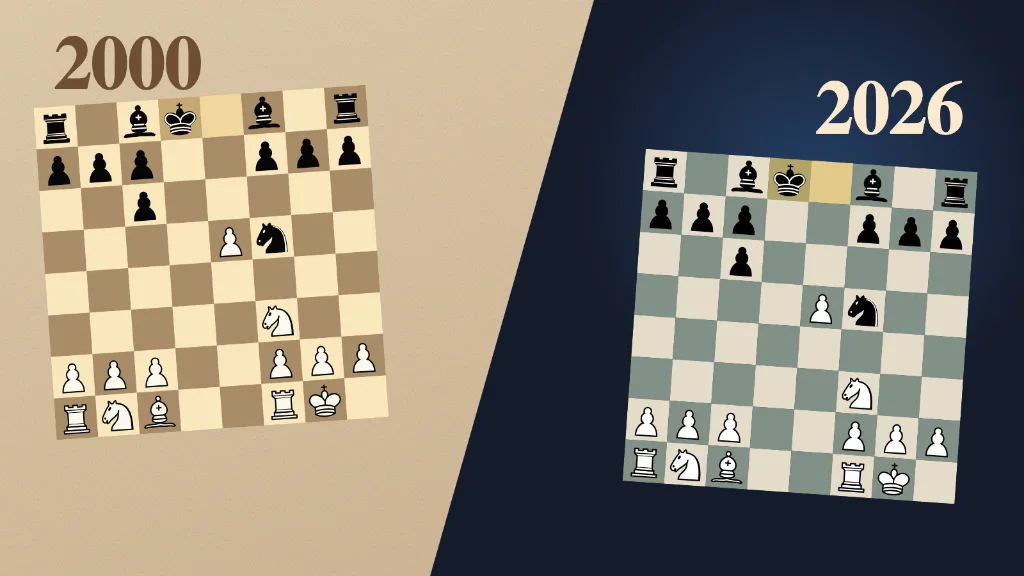
The Berlin Wall: from London 2000 to 2026
In 2000 the Berlin endgame helped decide a world championship. A quarter of a century later it is still on the board at the top level, in 4,330 master games and counting.
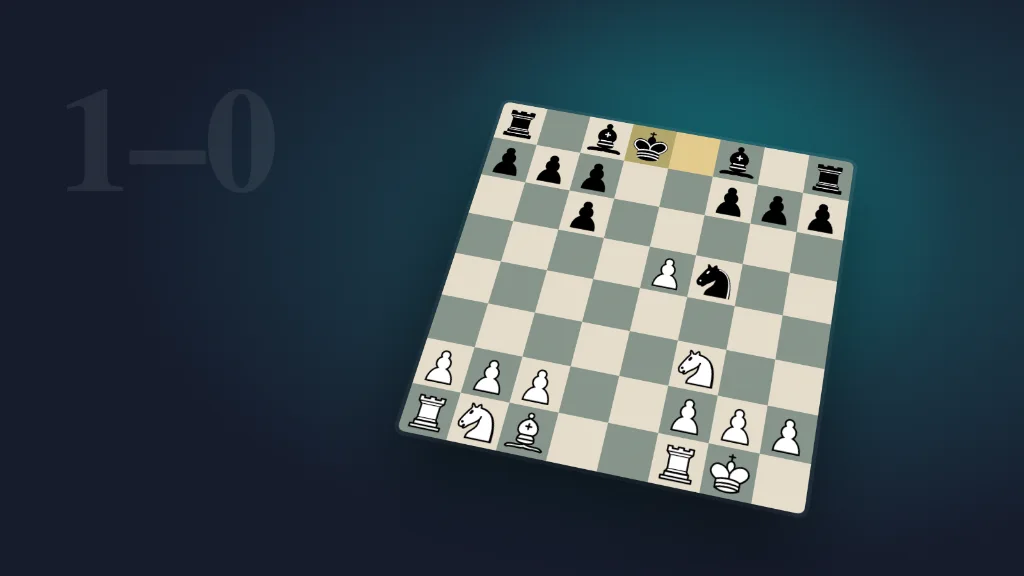
Caruana vs Carlsen, Norway Chess 2015: winning the 'drawish' Berlin endgame
The Berlin endgame is famous as a drawing line. Here is how White turned it into a win against the world champion, move by move, with Stockfish 19 checking every turning point.
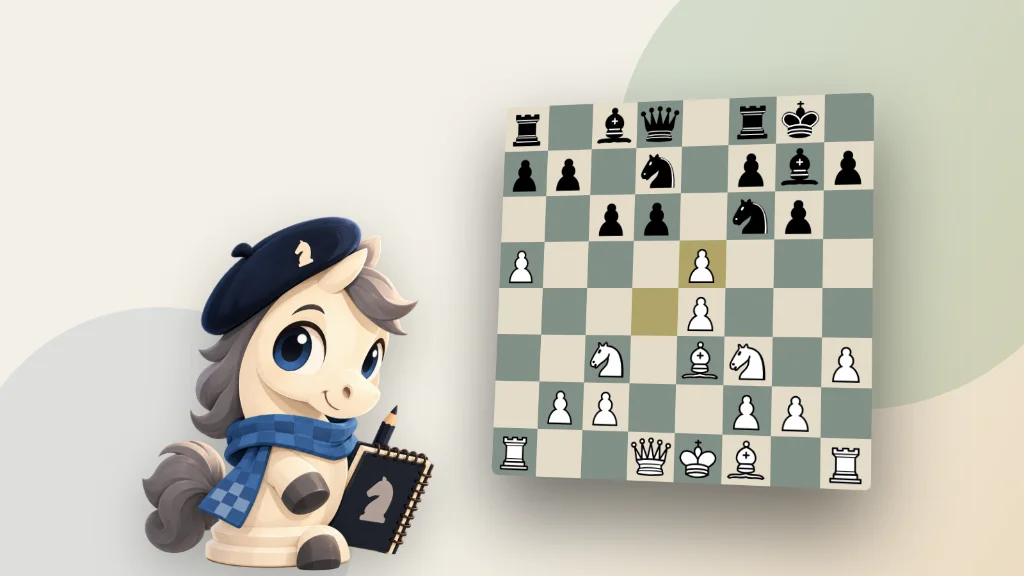
Before you recapture, look at the lines you open: a two-second check that saves games
In the Pirc, the natural recapture 9…dxe5? runs into 10.Qd6!, and White scores heavily in master games. Here is a simple habit that spots this kind of trap before you fall into it.