
Blast from the Past2000 2026
The Berlin Wall: from London 2000 to 2026
In 2000 the Berlin endgame helped decide a world championship. A quarter of a century later it is still on the board at the top level, in 4,330 master games and counting.

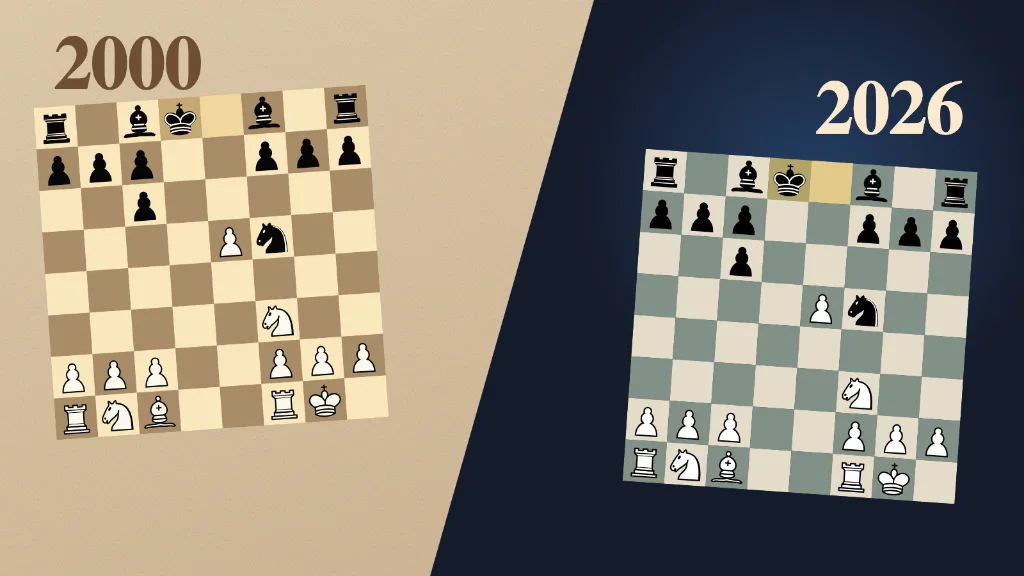
Then: London, 2000
In the Classical World Championship match in London, Vladimir Kramnik beat Garry Kasparov 8½–6½ without losing a game. His main defensive weapon against Kasparov's 1.e4 was an old, little-respected line of the Ruy Lopez: the Berlin Defence. Kasparov opened with 1.e4 in 5 of the games he played with White; Kramnik answered with the Berlin in 4 of them, and each time the game went into the queenless position it leads to after eight moves.
The Berlin endgame, as reached in London, 2000


 7
 65

 43
 2a1
 bc
 defg
 h
- 1
- 2
- 3
- 4
- 5
- 6
- 7
- 8
The Berlin endgame. Queens are off, Black's king has lost the right to castle, and Black has the two bishops.
Opens in a new tab at the position on this board, with what masters played from it.
Our database holds 4 games from 2000 between Kasparov, with White, and Kramnik that reached exactly this position. All 4 were drawn.
The idea
At first sight the position looks uncomfortable for Black: the king stands in the middle, White's pawn on e5 gains space, and White's pieces develop quickly. But Black's position has no weaknesses White can easily attack, the two bishops are a long-term asset, and with queens off the board the exposed king is hard to reach. The practical message of 2000 was that White's extra space was not enough to win.
Now: still on the board
The endgame did not go away. It is one of the most important positions in modern top-level chess:
Drawn does not mean dead. Recent top-level games in our database that reached this exact endgame include:
- Caruana–Carlsen, Norway Chess, 2015: White won.
- Nepomniachtchi–Vidit, FIDE Candidates, 2024: White won.
- Nepomniachtchi–Niemann, 2026: White won after a long endgame.
Then: London, 2000
765432a1bcdefgh- 1
- 2
- 3
- 4
- 5
- 6
- 7
- 8
Kramnik's four Berlin games in London, 2000: all reached this position, all were drawn.
Opens in a new tab at the position on this board, with what masters played from it.
Now: Nepomniachtchi–Niemann, 2026
765432a1bcdefgh- 1
- 2
- 3
- 4
- 5
- 6
- 7
- 8
- 9
- 10
- 11
- 12
- 13
- 14
- 15
- 16
- 17
- 18
- 19
- 20
- 21
- 22
- 23
- 24
- 25
- 26
- 27
- 28
- 29
- 30
- 31
- 32
- 33
- 34
- 35
- 36
- 37
- 38
- 39
- 40
- 41
- 42
- 43
- 44
- 45
- 46
- 47
- 48
- 49
- 50
- 51
- 52
- 53
- 54
- 55
- 56
- 57
- 58
- 59
- 60
- 61
- 62
- 63
- 64
- 65
- 66
- 67
- 68
- 69
- 70
- 71
- 72
- 73
- 74
- 75
- 76
- 77
- 78
- 79
- 80
The same position on move eight. Press ▶ or → to play on and watch White win the endgame.
Opens in a new tab at the position on this board, with what masters played from it.
Step through the second board to see how White, a quarter of a century on, turned the same queenless position into a win.
What changed, and what didn't
We are careful here: our database shows that the position keeps appearing and how it scores, not why individual players choose it. What the numbers support is simple. The Berlin endgame that Kramnik used to neutralise Kasparov in 2000 remains a standard, mostly drawn, still fully playable position for both sides at the highest level.
Sources and evidence14 checked claims
Every number in this article, where it came from and how it was checked. Master-database numbers are re-read from the live database and engine values re-run whenever the page is built. How we check
| Claim | Value | Source |
|---|---|---|
| Year of the London match (and of the four London games at this position) | 2000 | Position Explorer player search 'Kasparov' at the Berlin endgame, build c7ccea3a87ef, 27 Oct 2026 (tools/explorer-probe.mjs); four Kasparov–Kramnik games dated 2000, Kasparov 2849 v Kramnik 2770, all ½–½ |
| Kramnik beat Kasparov in the 2000 Classical World Championship, London: 8½–6½ (two wins, thirteen draws, no losses) | 8½–6½ | scripts/publishing/tools/match-probe.mjs "kasparov g" "Kramnik" 2000 <Berlin endgame moves>, ChessCanvas master database build c7ccea3a87ef, 29 Oct 2026; the 15 'Braingames WCC' games, 8 Oct–2 Nov 2000: Kramnik won on 10 Oct (game 2, 1-0 with White) and 24 Oct (game 10, 1-0 with White); the other 13 were drawn; Kramnik 2 + 13×½ = 8½, Kasparov 13×½ = 6½. Agrees with Classical World Chess Championship 2000 (Wikipedia); 25 years ago: Kramnik beats Kasparov (ChessBase) |
| Games of the London 2000 match in which Kasparov, with White, opened 1.e4 | 5 | scripts/publishing/tools/match-probe.mjs "kasparov g" "Kramnik" 2000 <Berlin endgame moves>, ChessCanvas master database build c7ccea3a87ef, 29 Oct 2026; Kasparov had White in 8 of the 15 games: 1.e4 on 8, 12, 22, 26 and 29 Oct; 1.c4 on 15 and 19 Oct; 1.d4 on 2 Nov |
| Of those 1.e4 games, the ones Kramnik answered with the Berlin Defence; each reached the queenless endgame after 8…Kxd8 and was drawn | 4 | scripts/publishing/tools/match-probe.mjs "kasparov g" "Kramnik" 2000 <Berlin endgame moves>, ChessCanvas master database build c7ccea3a87ef, 29 Oct 2026; 8, 12, 22 and 29 Oct (games 1, 3, 9 and 13): Berlin endgame reached, ½–½; 26 Oct (game 11): 3…a6, a closed Ruy Lopez |
| Games from 2000 between Kasparov (White) and Kramnik that reached the Berlin endgame in our database; all drawn | 4 | Position Explorer player search 'Kasparov' at the Berlin endgame, build c7ccea3a87ef, 27 Oct 2026 (tools/explorer-probe.mjs); 8 Kasparov games at the position, of which 4 are Kasparov–Kramnik 2000 (all ½–½), 3 Kasparov–Kramnik 2001, 1 Polgar–Kasparov 2002 |
| Over-the-board master games that reached the Berlin endgame | 4,330 | ChessCanvas master database c7ccea3a87ef, Modern masters · OTB (re-read at build) |
| White wins from the Berlin endgame | 1,225 | ChessCanvas master database c7ccea3a87ef, Modern masters · OTB (re-read at build) |
| Draws from the Berlin endgame | 2,230 | ChessCanvas master database c7ccea3a87ef, Modern masters · OTB (re-read at build) |
| Black wins from the Berlin endgame | 875 | ChessCanvas master database c7ccea3a87ef, Modern masters · OTB (re-read at build) |
| Share of Berlin endgames drawn | 52% | computed from rows endgame-draws and endgame-games |
| Stockfish's evaluation of the Berlin endgame (its first choice: 9.Nc3) | +0.1 | Stockfish 19 Lite, 2,000,000 nodes (re-run at build, tolerance ±0.15) |
| Caruana–Carlsen, 3rd Norway Chess, 17 June 2015, 1–0, reached the Berlin endgame | 2015 | ChessCanvas master database c7ccea3a87ef, reference games at the Berlin endgame position (scripts/publishing/masterdb.mjs referenceGames); game 13740869: players, event, date and result from the game record |
| Nepomniachtchi–Vidit, FIDE Candidates, 7 April 2024, 1–0, reached the Berlin endgame | 2024 | ChessCanvas master database c7ccea3a87ef, reference games at the Berlin endgame position (scripts/publishing/masterdb.mjs referenceGames); game 337807: players, event, date and result from the game record |
| Nepomniachtchi–Niemann, 25 May 2026, 1–0, reached the Berlin endgame (moves on the second board are this game's record) | 2026 | ChessCanvas master database c7ccea3a87ef, reference games at the Berlin endgame position (scripts/publishing/masterdb.mjs referenceGames); game 37833 (OTB classical): Nepomniachtchi–Niemann, 1-0, dated 25 May 2026 by its source, an official broadcast in the Lichess open database (CC BY-SA 4.0), which records the round ('Round 1') but no event name |
Keep reading
Same position, different order: how transpositions work, and why your database should count them once
Four different move orders reach the same Catalan position, and every one of them finds the same 45,726 master games. What a transposition is, and how to use it in your preparation.
The Queen He Saw Coming: how Geller stunned Karpov, and how Karpov answered a year later
In 1976 Efim Geller sacrificed his queen against the world champion, and Karpov saw it coming. A year later Karpov answered with a queen sacrifice of his own. Two games, verified move by move.
Before you recapture, look at the lines you open: a two-second check that saves games
In the Pirc, the natural recapture 9…dxe5? runs into 10.Qd6!, and White scores heavily in master games. Here is a simple habit that spots this kind of trap before you fall into it.